
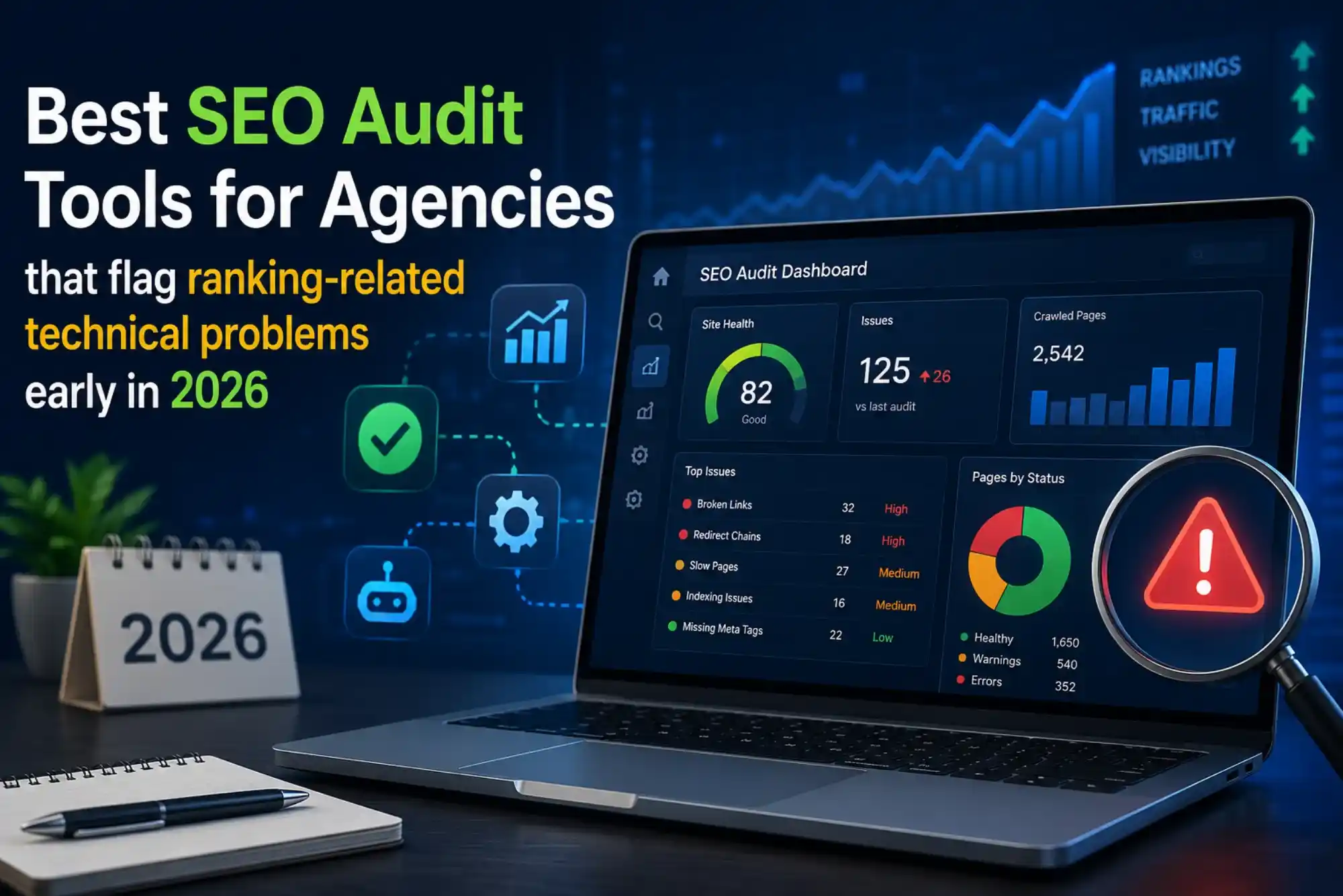
Technical SEO issues rarely announce themselves before rankings decline. A website may look perfectly functional on the surface while hidden crawl errors, indexing problems, slow-loading pages, broken redirects, and structured data issues quietly reduce search visibility. For agencies managing multiple client websites, discovering these problems early can mean the difference between preserving rankings and explaining sudden traffic losses.
Featured Snippet Answer: The best SEO audit tools for agencies in 2026 are platforms that identify technical issues before they impact rankings. Leading solutions help detect crawl errors, indexation problems, site speed bottlenecks, redirect chains, broken links, schema issues, and Core Web Vitals concerns while providing actionable recommendations for faster resolution and ongoing SEO performance monitoring.
The growing complexity of modern websites makes manual auditing nearly impossible at scale. Agencies require tools that continuously monitor websites, prioritize critical issues, and provide insights that translate into measurable SEO improvements.
Why Technical SEO Audits Matter More Than Ever in 2026
Search engines continue refining how they evaluate websites. Technical performance, crawlability, user experience signals, and structured data implementation play increasingly important roles in determining visibility.
Even the strongest content strategy can struggle when technical barriers prevent search engines from properly accessing, understanding, or indexing pages. Agencies serving competitive industries must identify these issues before rankings decline.
Businesses investing in digital growth often combine technical optimization with broader marketing initiatives. Similar principles are discussed in digital marketing agency strategies, where website performance directly influences campaign outcomes.

What Makes an SEO Audit Tool Valuable for Agencies?
Not all SEO tools are built for agency workflows. While freelancers may manage a handful of websites, agencies often oversee dozens or hundreds of client properties simultaneously.
The most effective platforms typically provide:
- Large-scale website crawling capabilities
- Automated issue detection
- Scheduled monitoring and reporting
- Client-friendly dashboards
- Issue prioritization systems
- Core Web Vitals tracking
- Indexation monitoring
- API integrations and automation features
- Competitor benchmarking
- Multi-user collaboration tools
These capabilities allow agencies to move beyond simple audits and create proactive SEO maintenance programs.
Comparison of Leading SEO Audit Tools for Agencies
| Tool Type | Best For | Key Strength | Agency Suitability |
|---|---|---|---|
| Enterprise Crawlers | Large Websites | Deep Technical Analysis | Excellent |
| Cloud-Based Auditors | Multi-Client Management | Automated Monitoring | Excellent |
| Site Monitoring Platforms | Issue Alerts | Real-Time Notifications | Very Good |
| Performance Auditing Tools | Core Web Vitals | Speed Analysis | Very Good |
| Integrated SEO Suites | All-in-One SEO | Comprehensive Reporting | Excellent |
Technical Problems the Best SEO Audit Tools Detect Early
Crawlability Issues
Search engines depend on efficient crawling to discover and evaluate content. Technical audit platforms identify blocked resources, crawl traps, orphan pages, and robots.txt conflicts that may prevent important pages from being indexed.
When agencies identify crawl inefficiencies early, they can preserve crawl budget and ensure critical content remains visible to search engines.
Indexation Problems
One of the most common reasons for ranking losses is improper indexation. Audit tools reveal pages that should be indexed but are excluded due to technical configurations.
Typical issues include:
- Accidental noindex tags
- Canonical errors
- Duplicate content conflicts
- Pagination mistakes
- Index bloat
Core Web Vitals and Site Speed Issues
Performance metrics remain a significant component of user experience evaluation. Agencies increasingly rely on audit software that identifies performance bottlenecks before they affect rankings or conversions.
Common findings include:
- Large image files
- Render-blocking resources
- Slow server responses
- Excessive JavaScript execution
- Poor mobile performance
Many agencies managing ecommerce projects also integrate technical SEO improvements with broader platform optimization efforts. For example, websites implementing SEO for Shopify stores often discover technical enhancements that significantly improve visibility.
Broken Links and Redirect Chains
Internal linking structures can deteriorate over time as websites grow. Audit tools help identify:
- 404 errors
- Broken internal links
- Redirect loops
- Redirect chains
- Lost link equity opportunities
Fixing these issues improves both user experience and search engine crawling efficiency.
Structured Data Errors
Schema markup helps search engines better understand website content. SEO auditing tools validate structured data implementation and identify errors that may prevent rich results from appearing in search.
Agencies increasingly use schema validation to support visibility improvements across competitive search results.
Features Agencies Should Prioritize in 2026
Automated Issue Prioritization
Modern websites can generate hundreds of technical warnings. The best tools separate critical ranking risks from minor optimization opportunities.
Without prioritization, SEO teams may waste valuable time addressing low-impact issues while serious technical problems continue affecting visibility.
Historical Monitoring
Tracking changes over time provides context that one-time audits cannot deliver. Historical monitoring allows agencies to:
- Identify recurring issues
- Measure improvements
- Track deployment impacts
- Demonstrate client value
Client Reporting Capabilities
Clients rarely want raw technical data. Agencies benefit from platforms that translate technical findings into business-focused reports.
The ability to communicate technical SEO performance clearly often strengthens client retention and trust.
Multi-Site Management
Agency operations depend on efficiency. Centralized dashboards reduce administrative overhead while making it easier to monitor multiple websites simultaneously.
This becomes particularly important when handling large portfolios across various industries.
How AI Is Changing SEO Auditing in 2026
Artificial intelligence is increasingly embedded within modern SEO platforms. Rather than simply reporting errors, newer tools explain why issues matter and recommend corrective actions.
Advanced platforms can:
- Predict ranking risks
- Highlight unusual traffic patterns
- Identify technical anomalies
- Recommend optimization priorities
- Detect emerging performance concerns
These capabilities help agencies act proactively instead of reacting after rankings decline.
[Insert relevant reference link here]
Common Technical SEO Mistakes Agencies Encounter
Across industries and website types, several technical issues consistently appear during audits.
- Improper canonicalization
- Duplicate metadata
- Thin indexable pages
- Broken internal linking structures
- Large image assets
- JavaScript rendering issues
- Poor mobile usability
- Missing XML sitemap optimization
- Incorrect redirects after migrations
- Orphaned content pages
These issues often accumulate gradually, making ongoing monitoring significantly more valuable than occasional audits.
How SEO Audit Tools Support Local and Enterprise Campaigns
Different projects require different auditing priorities.
For local businesses, agencies often focus on site performance, local landing pages, structured data implementation, and mobile usability. Organizations working to improve local SEO rankings frequently benefit from continuous technical monitoring that protects local search visibility.
Enterprise websites, however, may require large-scale crawl analysis, index management, international SEO validation, and advanced reporting capabilities.
The most effective audit platforms accommodate both scenarios through scalable infrastructure and customizable workflows.
Choosing the Right SEO Audit Tool for Your Agency
The ideal solution depends on client volume, reporting requirements, website complexity, and available resources.
When evaluating options, agencies should consider:
- Website crawl limits
- Automation features
- Integration capabilities
- Reporting quality
- Monitoring frequency
- Collaboration tools
- Data accuracy
- Scalability
Agencies focused on long-term growth should prioritize platforms that support both technical audits and ongoing SEO monitoring.
Technical SEO also works hand-in-hand with broader authority-building initiatives. Businesses seeking sustainable growth often combine audits with strategies outlined in resources about improving domain authority.
Conclusion
The best SEO audit tools for agencies in 2026 do far more than identify broken links or generate crawl reports. They function as early warning systems that help detect ranking-related technical problems before they affect visibility, traffic, and revenue.
As websites become more complex and search algorithms continue evolving, proactive technical monitoring is no longer optional. Agencies that invest in robust auditing platforms gain a competitive advantage through faster issue detection, improved client outcomes, and stronger long-term SEO performance.
Choosing the right solution ultimately depends on agency goals, but the most successful teams prioritize tools that combine automation, accuracy, scalability, and actionable insights. That combination remains the foundation of effective technical SEO management in 2026 and beyond.
Frequently Asked Questions
What is the primary purpose of an SEO audit tool?
An SEO audit tool identifies technical issues that may prevent search engines from properly crawling, indexing, and ranking a website.
How often should agencies perform SEO audits?
Comprehensive audits should typically be conducted quarterly, while ongoing monitoring should occur continuously to catch emerging issues early.
Can SEO audit tools improve rankings directly?
No. Audit tools identify problems and opportunities. Rankings improve when agencies implement the recommended fixes.
Are technical SEO audits necessary for small websites?
Yes. Even small websites can experience crawl errors, indexation issues, and performance problems that negatively affect search visibility.
What technical issue most commonly affects rankings?
Indexation problems, crawl barriers, and site speed issues are among the most frequent technical factors associated with ranking declines.
Related Reading: Best SEO Reporting Tools for Agencies Reporting Rankings and Visibility With Less Manual Work in 2026
Related Reading: Best Keyword Research Tools for Agencies tracking keyword movements with better research data in 2026