
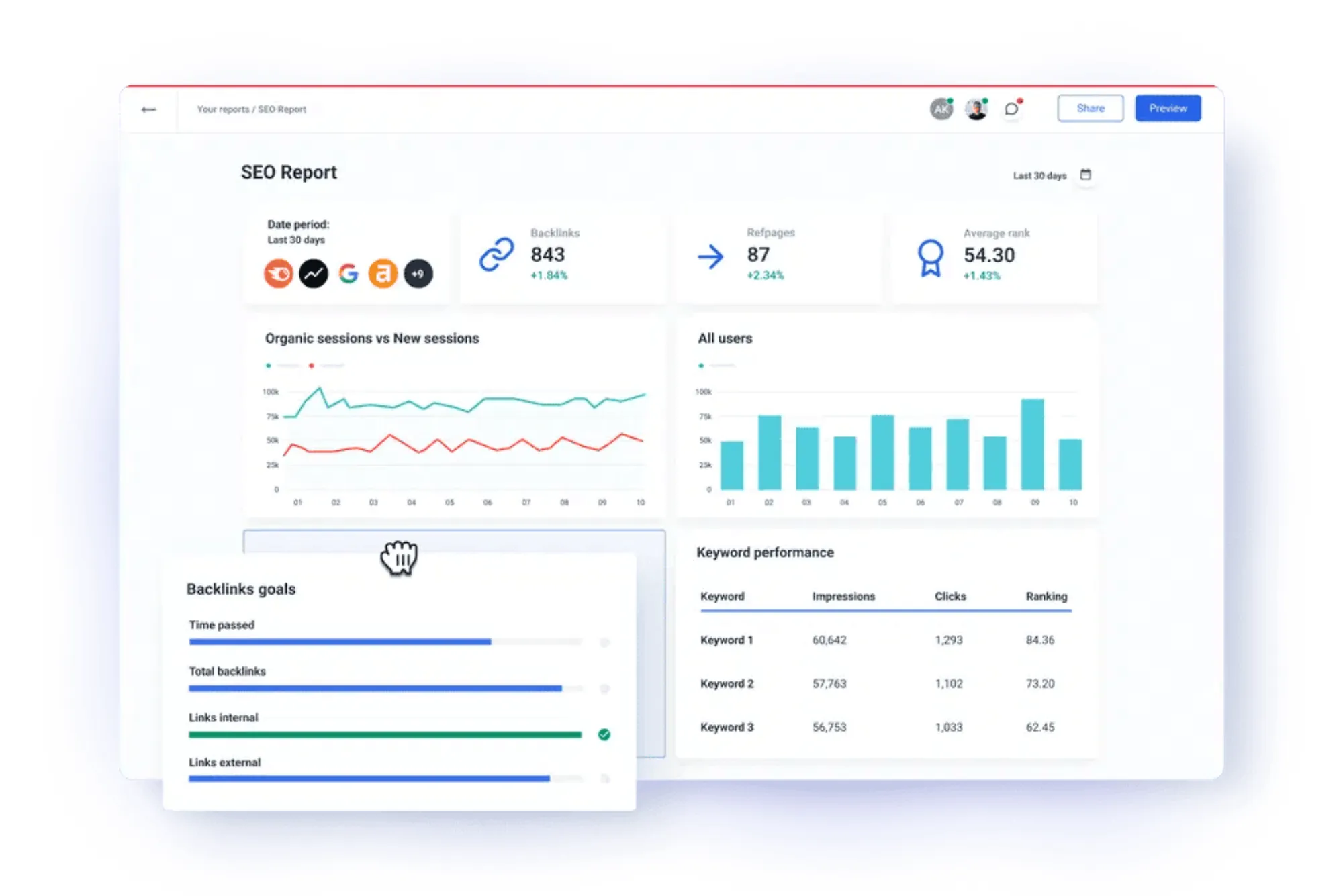
Agency life runs on reporting. Every week or month, clients expect a clear picture of how their website is performing in search — which keywords have moved, how visibility has shifted, what the traffic trends look like, and whether the work being done is translating into measurable progress. For years, producing these reports meant pulling data from multiple platforms, reformatting spreadsheets, and spending hours on work that added no strategic value. In 2026, that model is obsolete. The best SEO reporting tools for agencies now automate the entire reporting pipeline — from data collection to branded PDF delivery — freeing account managers and SEO specialists to focus on analysis and strategy rather than data wrangling.
This guide covers the most capable reporting platforms available to agencies this year, what distinguishes them from one another, and how to choose the right combination based on your client volume, reporting complexity, and budget.
Why Agency SEO Reporting Is a Different Challenge From Small Business Reporting
Agencies face reporting challenges that individual business owners simply do not encounter. Managing ten, twenty, or fifty clients simultaneously means that any manual step in the reporting process multiplies proportionally. A report that takes two hours to produce manually across one client becomes a forty-hour task across twenty clients — an unsustainable burden that consumes time that should be spent on strategy, optimisation, and client communication.
Beyond volume, agencies also face presentation requirements that differ from in-house teams. Reports need to be branded, consistent, and client-appropriate — meaning they must communicate clearly to stakeholders who are not SEO specialists, avoid exposing internal tooling or data sources, and convey the agency’s value clearly. White label reporting, automated delivery, and customisable dashboards are therefore not optional features for agencies — they are core requirements.
The best SEO reporting platforms in 2026 address all of these needs: they aggregate data from multiple sources automatically, generate branded reports on a schedule, track rankings across multiple client domains simultaneously, and present visibility trends in formats that non-technical clients can understand and appreciate.
Top SEO Reporting Tools for Agencies in 2026
The following platforms represent the strongest options available for agencies of different sizes, client mixes, and reporting complexity levels.

| Tool | Best For | Starting Price | Key Agency Features |
|---|---|---|---|
| AgencyAnalytics | Multi-client dashboard management | $12/month per client | White label branding, automated report delivery, drag-and-drop builder, 80+ integrations |
| Semrush | Full SEO suite with built-in reporting | $139/month (+ agency add-ons) | Branded PDF reports, position tracking, scheduled delivery, client portal |
| Ahrefs | Rank tracking and competitive visibility | $129/month | Share of voice, SERP history, traffic value, rank tracker by project |
| SE Ranking | Affordable white label reporting for growing agencies | $52/month | White label reports, client access controls, automated email delivery |
| DashThis | Automated marketing report templates | $45/month (3 dashboards) | Pre-built SEO templates, multi-source data, automated delivery, white label |
| Google Looker Studio | Custom, free report dashboards | Free | Fully customisable, connects to GSC, GA4, Ads; shareable live dashboards |
| Rank Ranger | Agencies needing advanced white label portals | $79/month | Custom domain reporting, client login portals, branded dashboards |
| Whatagraph | Multi-channel marketing reporting for agencies | $199/month | Cross-channel reporting, automated delivery, visual report builder, white label |
What Agencies Should Prioritise When Choosing a Reporting Tool
White Label Capabilities
White label reporting is the baseline requirement for most agencies. Clients should see your agency’s brand — your logo, colours, and domain — not the tool’s branding. The degree of white labelling varies significantly between platforms. AgencyAnalytics and Rank Ranger offer the most comprehensive white label options, including custom client login portals under your own domain. SE Ranking and DashThis provide strong branded PDF output but with less complete portal-level white labelling. Google Looker Studio can be fully customised visually but requires more setup time.
Automated Scheduling and Delivery
For agencies managing multiple clients, automated report delivery is non-negotiable. The ability to schedule monthly or weekly reports that are generated and delivered to client email addresses without manual intervention is the single feature that has the most direct impact on agency efficiency. Every platform listed above supports scheduled delivery to some degree, but the flexibility of scheduling options — and the reliability of delivery — varies. AgencyAnalytics and Semrush are particularly strong here, with granular control over delivery timing, frequency, and recipient lists per client.
Multi-Client Rank Tracking
Rank tracking at scale is a different challenge from tracking one site. Agencies need tools that can manage keyword sets across dozens of client domains simultaneously, segment tracked terms by client, and surface changes across all accounts in a single view. Semrush, SE Ranking, and Ahrefs all handle this well through project-based organisation. AgencyAnalytics excels at the dashboard aggregation layer, pulling rank data from connected sources and displaying it in client-specific views.
Data Source Integration
The strongest reporting tools pull data from multiple sources — Google Search Console, Google Analytics 4, Google Business Profile, and in some cases Google Ads — and present it in a unified client view. DashThis and Whatagraph are particularly strong on multi-source integration, making them excellent choices for agencies that report on paid search and social alongside organic. For agencies focused primarily on organic SEO, Semrush and SE Ranking provide sufficient integration without the additional complexity.
Pricing Comparison for Agency-Level Reporting
Budget is a legitimate consideration for agencies, particularly when tool costs need to be factored into service pricing or overhead. The table below provides a realistic comparison of what different investment levels deliver for agencies.
| Monthly Budget | What to Expect | Recommended Tools |
|---|---|---|
| Free to $50 | Basic automation, Google data integration, manual customisation required | Google Looker Studio, DashThis Starter |
| $50 – $100 | White label reports, multi-client rank tracking, scheduled delivery | SE Ranking, DashThis Professional, Rank Ranger |
| $100 – $200 | Full-suite SEO reporting, competitor data, branded client portals | AgencyAnalytics, Semrush, Ahrefs |
| $200 and above | Cross-channel reporting, enterprise automation, multi-team access | Whatagraph, Semrush Business |
For most growing agencies managing between five and twenty clients, the $50 to $150 range offers the best balance of capability and cost efficiency. Platforms like SE Ranking and AgencyAnalytics are designed specifically for this tier and offer functionality that scales as the agency grows. [Insert relevant reference link here]
How Automated SEO Reporting Changes Agency Operations
The operational impact of moving from manual to automated SEO reporting is significant and extends beyond time savings. When reports are generated automatically, account managers spend their client communication time on analysis and recommendations rather than data preparation. This shifts the client relationship from information delivery to strategic consultation — a much higher-value activity that justifies premium service pricing and strengthens client retention.
Automated reporting also reduces the risk of human error. Manually assembled reports are prone to data inconsistencies, copy-paste mistakes, and formatting issues that can undermine client confidence. Tool-generated reports pull directly from source data, apply consistent calculations, and present information in a standardised format every time. This consistency builds trust and presents the agency as organised and professional regardless of team size.
For agencies serving clients in sectors with strong local search intent — from cleaning companies to transport providers — automated reporting can also be configured to surface local-specific metrics such as Google Business Profile impressions, local pack appearances, and geo-segmented rank data. Agencies managing visibility for businesses in the cleaning company sector in the UAE, for example, benefit from reporting setups that clearly distinguish between branded and non-branded local search performance.
Building an Efficient Agency Reporting Workflow in 2026
Choosing the right tool is only part of the equation. The way reports are structured and delivered matters equally. Here is a practical approach to building an agency reporting workflow that scales efficiently:
Standardise your report template: Create a master template with consistent sections — executive summary, keyword ranking changes, organic traffic trends, top-performing pages, and next-month priorities. This template should be adaptable to individual client contexts but structurally consistent across all accounts.
Set up automated data connections: Connect Google Search Console, Google Analytics 4, and any paid channel data at the project setup stage. Do this once per client and let the tool pull data automatically going forward.
Configure per-client keyword groups: Organise tracked keywords into topic groups for each client. This makes reporting more meaningful — showing performance by product category, service area, or content cluster rather than a flat list of individual terms.
Schedule delivery before the month starts: Set automated delivery to reach client inboxes by the second or third working day of each month. This creates a reliable reporting cadence that clients can plan their own review meetings around.
Include a commentary layer: Automated data without context is limited in value. The most effective agency reports include a short written commentary — two to three paragraphs — interpreting the data and connecting changes to actions taken or planned. This is the layer that demonstrates strategic value and cannot be automated.
Reporting for Specialist Sectors: Adapting Metrics to Industry Context
Different industries require different reporting emphases. Agencies serving software companies prioritise branded keyword defence, share of voice against specific competitors, and conversion-focused landing page performance. Agencies working with logistics or transport businesses focus more heavily on local pack visibility, mobile search performance, and geo-segmented rank data.
Understanding the metrics that matter most to each client’s industry makes reporting significantly more valuable. A report that tracks the right things and explains them in industry-relevant terms builds far more client confidence than a generic template applied uniformly across all accounts. Agencies serving clients in the software industry in the region, for instance, should weight their reporting toward competitive visibility metrics and branded search share rather than pure rank movement.
Transport and logistics clients, meanwhile, benefit from reports that highlight local search performance across specific cities or routes. Agencies managing visibility for transport companies in the UAE should ensure their reporting setup captures geo-segmented rank data and Google Business Profile insights alongside standard organic metrics.
Frequently Asked Questions
What is the best SEO reporting tool for a small agency just starting out?
SE Ranking offers the best combination of affordability, white label reporting, and multi-client functionality for growing agencies. Google Looker Studio is also a strong free option for agencies willing to invest time in initial setup, as it allows fully customised branded reports connected to Google’s own data sources.
Can SEO reporting tools track local rankings for multiple clients simultaneously?
Yes. Tools including SE Ranking, Semrush, and AgencyAnalytics support location-specific rank tracking across multiple client projects. This is particularly valuable for agencies managing local service businesses where rankings differ significantly by city or region.
How do I justify the cost of a reporting tool to my agency’s leadership?
Calculate the hourly cost of manual report production across all clients, then compare it to the tool’s monthly subscription. Most agencies find that automating reporting saves between five and twenty hours per month — a saving that far exceeds the tool cost, even at mid-tier pricing, while also improving report quality and consistency.
What is white label SEO reporting and why does it matter for agencies?
White label reporting means client-facing reports carry your agency’s branding — logo, colours, and custom domain — rather than the software provider’s name. This is important because it maintains a professional agency presentation, protects your tooling choices from client visibility, and reinforces your brand with every report delivered.
Final Thoughts
The agencies that operate most efficiently in 2026 are those that have removed manual work from their reporting process without sacrificing the quality or depth of insight they deliver to clients. The right SEO reporting tool does not replace agency expertise — it amplifies it, by freeing the time that expertise is applied to and ensuring that data is always current, consistent, and professionally presented.
Whether your agency is managing five clients or fifty, the core principle is the same: automate what can be automated, standardise what should be consistent, and reserve human analysis for the interpretation and strategy that machines cannot provide. The tools covered in this guide make all of this achievable at every budget level. For agencies working across sectors including landscaping, healthcare, and technology in the regional market, staying current with sector-specific performance benchmarks and best practices through resources like technology and IT industry insights can help ensure that reporting strategy evolves in line with the competitive environment.
Related Reading: Best Keyword Research Tools for Agencies tracking keyword movements with better research data in 2026
Related Reading: Best SEO Audit Tools for Agencies that flag ranking-related technical problems early in 2026
Related Reading: What Is a Metal Finder Machine and How Does It Work?